Meryl Innerfield knows what it takes to keep young learners engaged, especially in a fully virtual classroom. With years of experience teaching early elementary students, she combines strong instructional routines with purposeful edtech to help students build confidence and mastery across all subject areas.
Meryl is a veteran elementary educator, currently teaching first grade in a virtual school program. She brings more than a decade of classroom experience, primarily in K–2, and has been recognized as the 2021-2022 Elementary School Teacher of the Year for her district and the 2026-2027 Teacher of the Year at her school. Now teaching in a fully virtual elementary model, she continues to do what she’s always done best: help young learners thrive.
Meryl’s approach is grounded in both expertise and passion, using her gifts to blend technology with instruction and build meaningful classroom communities. “I love working with young learners and using edtech with young learners. I've been a presenter at the school, the district, and the state level, sharing my passion for education and for teaching young learners, especially using educational technology in order to help young learners learn more, learn better, learn faster, and learn with more understanding,” said Meryl.
A day in the life of a virtual teacher
For teachers exploring virtual learning, Meryl’s classroom offers a clear, practical model grounded in structure and flexibility. Her students begin each day with live whole-group instruction, followed by targeted small-group sessions and independent, asynchronous work assigned throughout the week.
Rather than increasing passive screen time, this approach ensures students stay actively engaged through a mix of direct instruction, guided practice, and choice-based tasks. The result is a balanced learning experience that supports both accountability and independence in a fully virtual setting.
Discovering Reflex: A math fact fluency program for virtual classrooms
Meryl’s journey with Reflex started the way many teachers discover new tools: by trying to solve a real classroom problem. While teaching first grade, she was looking for a better way to build math fact fluency, something more effective than traditional memorization.
After starting with a free Reflex trial and later securing a Reflex Grant, the results were clear. “By the end of the year, my students had grown so much that there was just no denying that students who were using Reflex grew more than students who weren't,” said Meryl.
That success led to schoolwide adoption. Eventually, Meryl went from user to leader, supporting other teachers in implementing the program. “We do use some other digital math programs. The difference is that Reflex is a targeted, focused automaticity program,” said Meryl. “Reflex is automaticity. That’s its thing. That’s what it’s there for. And because it’s targeted, it does it really well.”
Using Reflex in a virtual classroom
Meryl keeps implementation simple and consistent, even in a fully virtual model. Reflex is built into weekly expectations as part of independent student work. Because Reflex fits naturally into asynchronous time, students can practice at their own pace while still meeting clear goals, making it an easy, scalable routine for virtual learning.
“As part of their assignment, students need to get three Green Lights a week. They think they're playing, and I think they're learning, and everyone wins.”
Why students love Reflex
For Meryl’s students, Reflex doesn’t feel like practice, but play. “The really special thing about Reflex is that the kids aren’t sitting there thinking that they’re doing math facts. They just want to play the game.”
The built-in differentiation also ensures every student can succeed. “The facts are different. The games are the same,” said Meryl. “We can both be playing the same game, but my facts and your facts are totally different based on our needs. But anybody walking by and looking at both screens says, ‘Oh, look, they’re playing the same game!’ That’s one of the really great things about Reflex: the math is hidden in the fun.”
This combination of engagement and accessibility keeps students coming back. Whether they’re just starting with basic math facts or working at higher levels, they’re all participating in the same engaging learning experience.
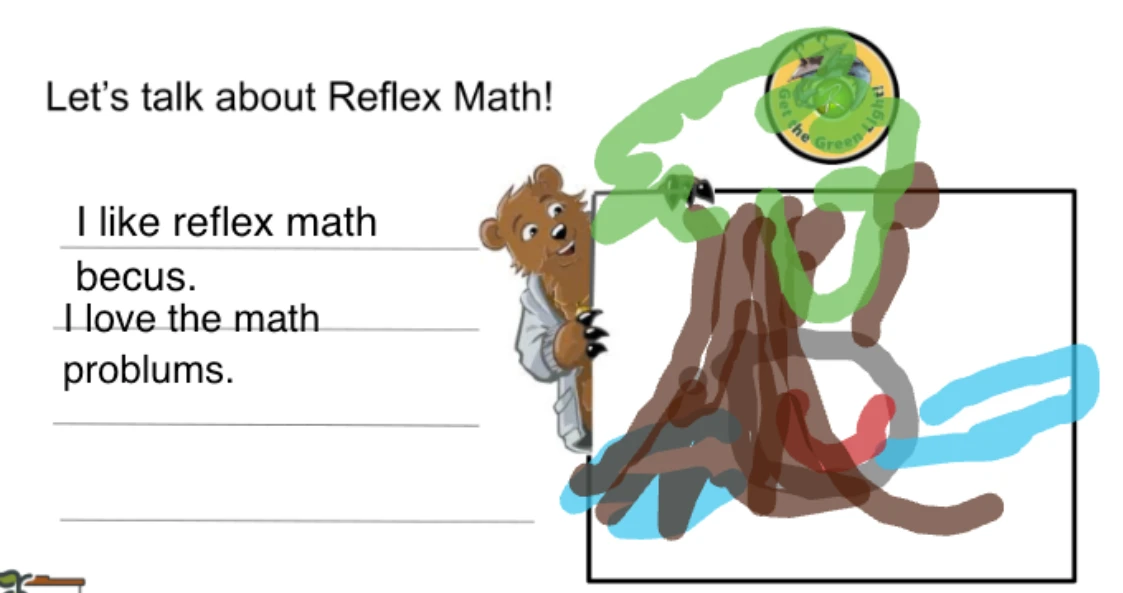
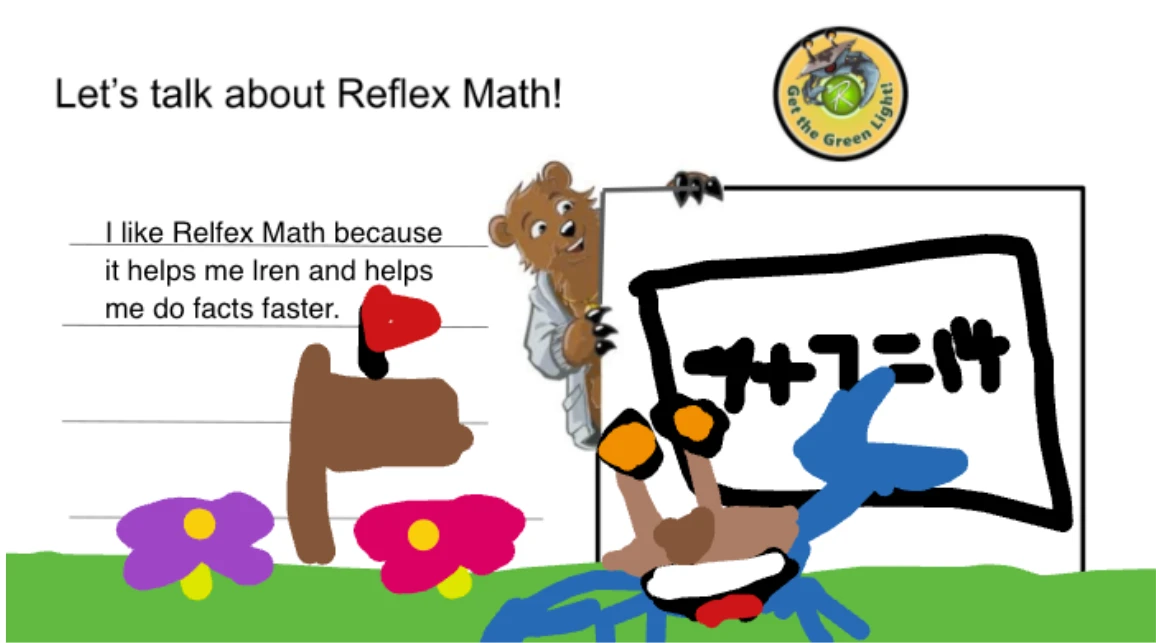
Meryl’s first-grade students shared their favorite parts about Reflex in a virtual classroom activity.
Strengthening confidence and math fact fluency with Reflex
For Meryl, the impact of consistent, targeted practice is clear, not just in math, but across her students’ overall confidence. “They are so much more confident in all of the other math work they do,” said Meryl. She regularly hears students make connections during lessons, recognizing when something they’ve practiced in Reflex shows up in their daily work.
“I cannot tell you how many times we're doing something in math and one of my kids says, ‘I learned that on Reflex. That's a Reflex fact. I know that one. I learned it on Reflex.” -Meryl Innerfield, Teacher
That growth is closely tied to the standards Meryl teaches. “Two of the things that we grade for on our report cards are to represent and solve addition and subtraction problems within 20 and recognize part-part-whole relationships for numbers up to 20. Both of those are affected and supported by Reflex. The automatic fact recall that Reflex is so good at directly applies to [our standards] of representing and solving addition and subtraction problems.”
Beyond memorization, Meryl emphasizes how Reflex helps students understand how numbers work together. “When students are learning not just the facts, but how they relate to each other—that 2 plus 3 is 5, and 3 plus 2 is 5, and 5 minus 3 is 2, and 5 minus 2 is 3… they’re not just learning a single fact in isolation.”
Instead, students build deeper number sense. “They’re learning how they affect each other and how they go together and how one fact can support another fact. That ties directly into what we’re looking for for our report cards and for our standards and our grading.”
Celebrating success and building classroom community
Just as important as skill-building is the classroom culture that develops alongside it. Meryl intentionally shifts the focus from pressure to progress, creating an environment where every student feels valued. Her Reflex class motto captures that mindset: “Every Green Light Counts.”
During each Reflex session, students stay motivated as they work toward the Green Light, a simple visual indicator that shows their daily progress in math fact fluency. As students answer facts correctly, the ring fills in, turning green once they’ve met their goal.
Students track their growth together and celebrate shared wins, building both accountability and encouragement into their routine. Meryl infuses moments for authentic celebration into her virtual classroom, including virtual shout-outs, certificates, and classroom growth monitors.
“In class, we track the progress we are making as a group. This is a community building activity for us, where every Green Light earned by the class that month gets celebrated. We check the number of Green Lights earned from the competition page and record them on our class tracker daily,” said Meryl. “Since printing and passing out milestone certificates isn’t feasible in a virtual classroom, we celebrate with ‘shoutouts’ instead. Students get shoutouts for individual achievements and we celebrate class shoutouts as a group.”
Fueling school-wide motivation with Reflex Competitions
Meryl extends engagement beyond her own classroom by turning Reflex into a school-wide motivator with Reflex Competitions. “Last year, the second grade teacher and I did competitions monthly. This year when I found out that some of the older kids were struggling with fact fluency, I opened the contest up to the whole school.”
By combining school-wide competition with class-level goal setting, Meryl creates a system where students are motivated by both friendly competition and shared achievement.
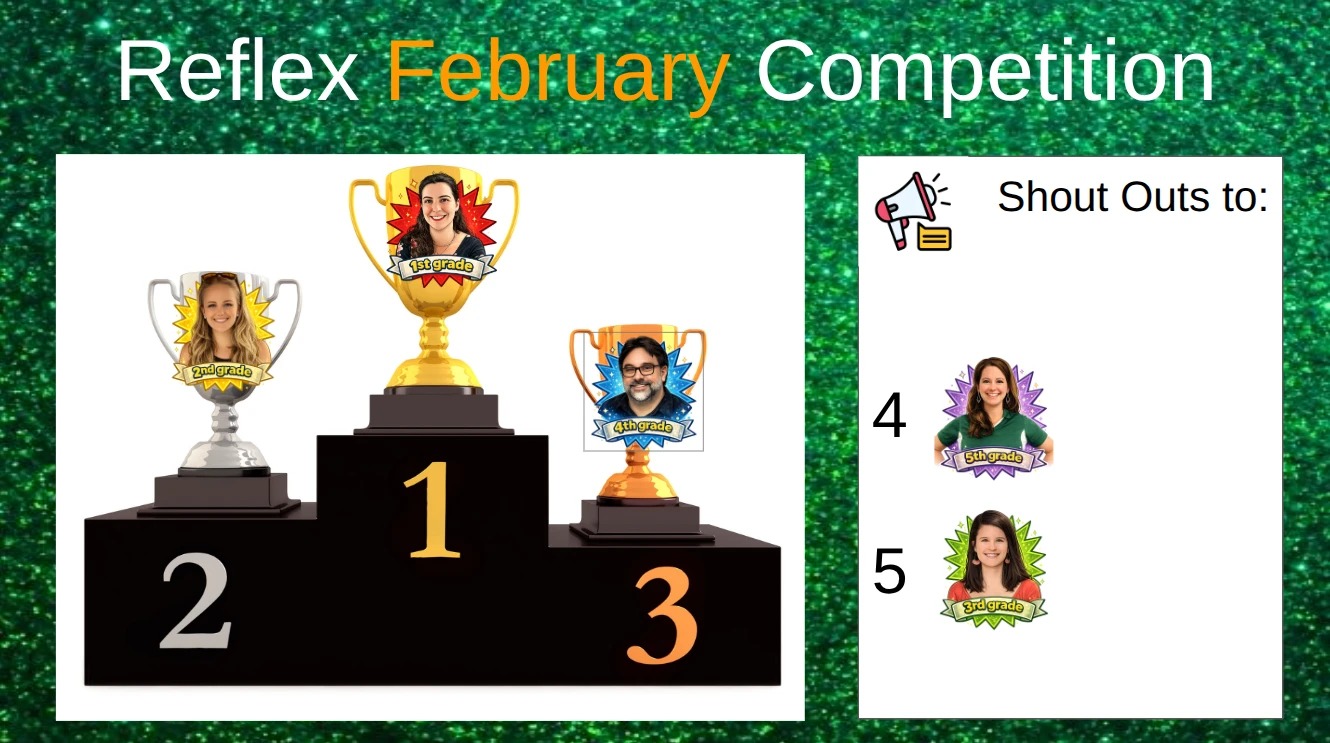
Meryl displayed and celebrated the results from a school-wide competition in her virtual classroom.
Using data to monitor and celebrate growth
Reflex also makes it easy to communicate progress with both students and families. With clear, visual data, students can track their own math fact fluency growth over time, building ownership and motivation along the way. This visibility makes growth tangible and easy to share. “It’s very easy to tell students and parents, ‘This is where you started and this is where you are now.’”
“I’m not the gatekeeper of the data,” explained Meryl, highlighting how accessible insights help families focus on what students are ready to learn next. Students also have direct access to their own Reflex progress, which builds ownership and independence. By showing exactly what math facts students know, what they’re working on, and what comes next, the Reflex data helps measure progress and gives families a clear path to support learning at home.
Discover how Reflex works in your classroom
At the heart of Meryl’s work are the moments that matter most. “My favorite part about teaching is seeing kids get it… that ‘aha’ moment where they realize, ‘I can do this now.’ Kids get so excited and they want to be able to show you, ‘Look what I can do.’ Being a part of making that happen is pretty amazing.”
Considering Reflex? “Take the free trial. It’s worth it,” said Meryl. “You will be amazed at how fast they grow, even the little ones.”
Meryl Innerfield has been teaching young learners since 2009. She loves using technology to help support instruction, and showing that little learners can be successful in a virtual environment. She has shared this passion at the local and state level. Her passions include bringing technology into the classroom, gamification, and teaching beginning readers. When not in the classroom, you can find her in the garden or playing with her dogs.