
Meet Samantha Bluestein
First-grade gifted teacher, Samantha Bluestein, knows just how pivotal the school year is for math. “First grade is such an important grade because it really lays the foundation of their education.”
Samantha teaches at Waters Edge Elementary School in Boca Raton, Florida. She began her teaching career in second grade after graduating from the University of Florida with her Master’s degree, before moving to first grade, where she’s been for the last two years.
Even though Samantha’s first-grade gifted students are young, she knows the critical role that addition and subtraction facts play in their current and future computational skills. She heard about Reflex, an adaptive and game-based math fact fluency program, from coworkers and decided to give it a try in her own classroom.
Starting the Reflex pilot
Samantha’s school participated in a Reflex pilot, which allowed her to use the math fact fluency program with her students for an extended period. Her goal was simple: help students master addition and subtraction facts through 20 so they could spend less time on computation and more time on problem-solving.
Most students begin using Reflex in grade 2, but Samantha’s gifted-and-talented students started a bit earlier. Before developing automaticity with addition facts, students should acquire basic connections between addition, cardinality, and counting. Teachers can use the Reflex Readiness Quiz and other pre-Reflex recommendations to ensure students are ready.
As a student advances in a Reflex game, the system continuously adjusts the difficulty of math fact retrieval based on their progress, providing an adequate level of challenge within the limits of their current abilities, ideal for the advanced learners in Samantha’s first-grade class.
She easily integrated Reflex into her daily classroom schedule. “Students go on Reflex after they finish their math work. This usually gives them about 20 minutes a day to use it.”
How Reflex changed her first-grade classroom
Samantha observed a clear improvement in her students’ math fact fluency after introducing the game-based program. “Reflex has really helped build my students’ fluency and automaticity,” said the teacher. “I have seen such a difference during our math lessons. We can spend a lot less time on the actual computation and more time dissecting word problems.”
“My lessons have been moving a lot smoother since they know their addition and subtraction facts better!” Instead of reminding students how to count on or count back, Samantha can now teach advanced strategies or dive into more complex math problems.
Samantha saw her students becoming more accurate and confident with their math facts. “I have seen that addition and subtraction come a lot easier to students. They are becoming automatic with facts 0–20.” And that automaticity didn’t just improve computation—it strengthened students' ability to tackle more complex tasks and the overall flow of math lessons.
“A big focus in first grade is learning how to add and subtract numbers 0-20. Reflex is perfect for practicing that! It is helping them master these facts a lot quicker.”
–Samantha Bluestein
The gains were evident not only in daily practice but also in her students’ classwork and assessments. “A lot of errors on tests now are due to misunderstandings and not due to miscalculations.”
Changes in student engagement and buy-in
Samantha also noticed a shift in students’ attitudes toward math, reporting that Reflex has made math time more enjoyable and less stressful. “My students have been so excited to use Reflex,” said the teacher. Reflex Competitions have also been a big hit in her classroom. “The competitions really motivate students to get on Reflex. They are so engaged and motivated to unlock new games and prizes.”
Unlike other math programs that focus primarily on repetition or speed, Reflex balances practice with engagement. Students are motivated to improve because the program is engaging and rewarding rather than monotonous. “I used IXL briefly in second grade. Reflex is a lot more engaging and exciting for students,” said the teacher.
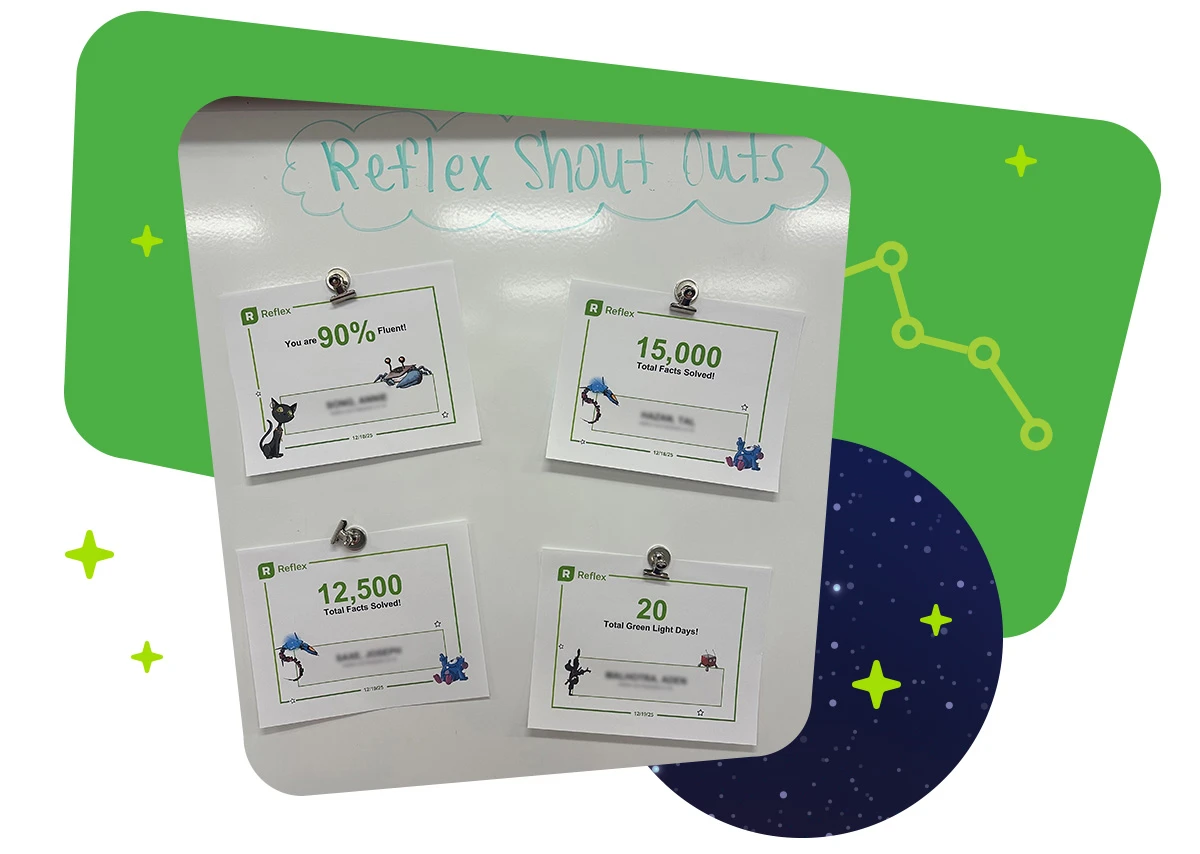
Reflex milestone certificates are on display in Samantha’s classroom.
“Students love playing the games and unlocking new features. I think they even forget that they are doing math when using Reflex. They are constantly asking when they can go on it. It has quickly become their favorite computer program.”
–Samantha Bluestein
Teaching with Reflex
Samantha uses Reflex’s reports to monitor students’ progress and inform her instruction. “The data reports help me see which students are improving and which students still need to practice their math facts.”
One of the biggest changes Samantha also noticed was how Reflex helped her manage students who finished work quickly without losing instructional momentum. “Reflex has been a great activity for my early finishers.” Instead of searching for extra worksheets or busywork, students can immediately transition to a meaningful, individualized math activity that supports their learning.
From Pilot to purchase
After piloting the program, Samantha’s school decided to purchase Reflex based on increased student engagement and noticeable growth in math fact fluency across the classroom.
Why Samantha committed to Reflex
“Reflex has made my students a lot more excited about math. It has changed their outlook and is making them stronger mathematicians,” said Samantha. The combination of engagement, adaptive learning, and measurable progress convinced her that Reflex was a lasting solution for her classroom.
Advice for other teachers considering Reflex
Are you curious to experience the difference Reflex can make in your classroom? Try Reflex for free and see how students’ math fact fluency and math attitudes can change in a few short weeks.

Samantha Bluestein
Samantha Bluestein currently teaches first grade at Waters Edge Elementary in the Palm Beach County School District. She graduated from the University of Florida with her Master’s degree and began teaching in a second-grade classroom. Samantha then moved to first grade, where she’s been teaching for the last two years.