
Students in Tanzania using Frax through the Cambium Global Impact Pilot
In communities across Sub-Saharan Africa, the urgency for scalable and innovative learning solutions is growing rapidly. By 2030, it’s estimated that this region will be home to half of all new entrants to the global workforce, and by the turn of the century, half of the world’s newborns. At the same time, millions of learners still face educational barriers. UNESCO estimates that meeting the needs of future generations will require 9 million new classrooms, 9.5 million more teachers, and an additional 19 billion USD in funding over the next decade.
Solutions that support teachers and maximize instruction time can’t wait—and with Cambium Learning Group partnering closely with dedicated school leaders across Sub-Saharan Africa, classrooms are beginning to see progress sooner rather than later. Cambium’s new Global Impact Pilot is designed to evaluate whether edtech tools can function with minimal infrastructure, improve learning in meaningful ways, and expand to serve more schools across the region.
A Pilot program reaches new communities
As part of the pilot, four schools in Tanzania and the Democratic Republic of the Congo (DRC) are using Gizmos, interactive math and science labs and simulations, with two also introducing Reflex and Frax, math solutions proven to increase math achievement in fractions and math fact fluency.
To help launch the pilot and support hands-on training with educators, Senior Learning Designer Jesse Mercer traveled to DCT Bishop Stanway School, just outside Dodoma, Tanzania. More recently, he arrived in Kinshasa, the capital of the DRC, to continue this work with our partner schools there.
Located on the southern bank of the Congo River, Kinshasa is one of the world's fastest-growing megacities. It’s home to over 17 million people–that’s over twice the population of New York City. Most residents live in the city’s urban center, creating high density that has outpaced city planning and strained utilities like electricity and water. Despite these challenges, Kinshasa remains a cultural powerhouse, known for its strong sense of community, remarkable creativity, and status as one of Africa’s most influential cities.
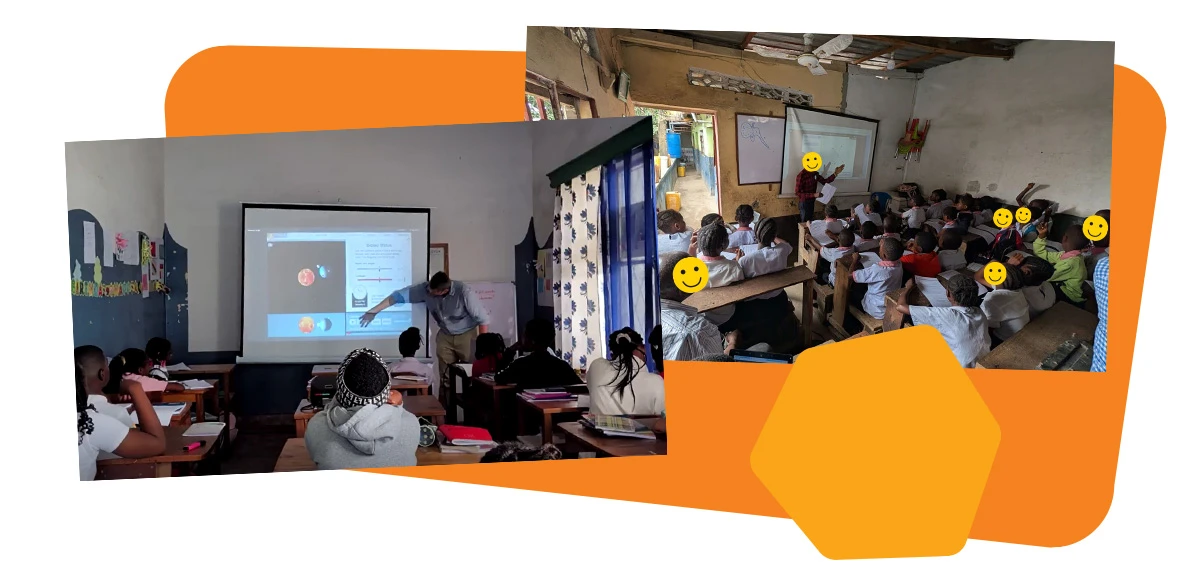
Gizmos in use at FATEB Kinshasa Academy (left) and Medik School (right) in Kinshasa, DRC
The pilot worked with two schools in Kinshasa, FATEB and Medik. FATEB, a private school with about 250 students, is one of two sites piloting all three ExploreLearning solutions: Gizmos, Reflex, and Frax. Medik is a private institution with nearly twice as many students as FATEB, resulting in a stretched teacher-to-student ratio of 1:50.
During the first few days at FATEB, Jesse led sample lessons with students in the morning and facilitated educator trainings in the afternoon with teachers from both partner schools. By mid-week, teachers were confidently introducing the tools on their own.
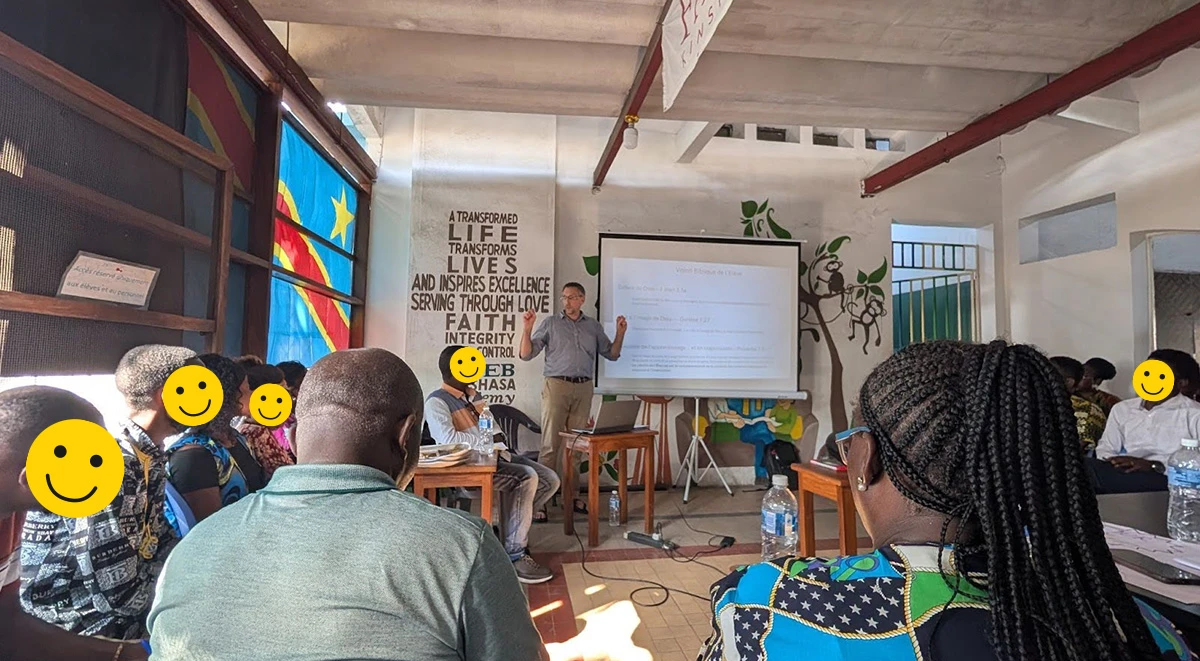
Jesse hosting a teacher training session with Gizmos at FATEB
Implementing Gizmos
Inquiry-based tools like Gizmos represent a meaningful opportunity to expand on traditional instructional practices. Instruction in this community is often lecture-based and centered on the teacher at the chalkboard. However, most educators have smartphones, and schools can access the internet through 5G routers.
By using a portable digital projector and the school’s existing internet access, Gizmos could be introduced to every classroom with minimal cost. Because the financial and time investment required to get started was so low (and the long-term sustainability so evident), educators and school leaders were enthusiastic about exploring this new opportunity for inquiry-driven learning.
Bringing abstract concepts to life
On day one, Jesse introduced students at FATEB to the Seasons in 3D Gizmo, which lets learners observe Earth’s orbit and the tilt of its axis in three dimensions. Although Kinshasa, near the equator, does not experience four distinct seasons, the simulation helped students visualize how Earth–Sun relationships influence climate globally.
The ability to download a modifiable exploration guide meant the simulation could be adapted to local realities, supporting teachers as they began experimenting with hands-on, inquiry-based lessons.

Senior Learning Designer Jesse Mercer teaching Seasons in 3D Gizmo at FATEB
Teachers appreciated how the program brings challenging concepts down to Earth. “We loved the [Gizmos] lesson because students are now in the realm of the concrete,” says Esdras Kintoki, a FATEB educator who observed the lesson, “because the way we’ve been teaching [before using Gizmos], it’s more abstract.”
Educators quickly took to the simulations and were implementing them in no time. After a few hours of Gizmos exposure, sixth-grade teacher Merlin Mwanza hosted an engaging lesson using the Plants and Snails Gizmo: Leveraging Gizmos supplementary materials like the Student Exploration Sheet, encouraging class discussion, and relying on inquiry-based practices.
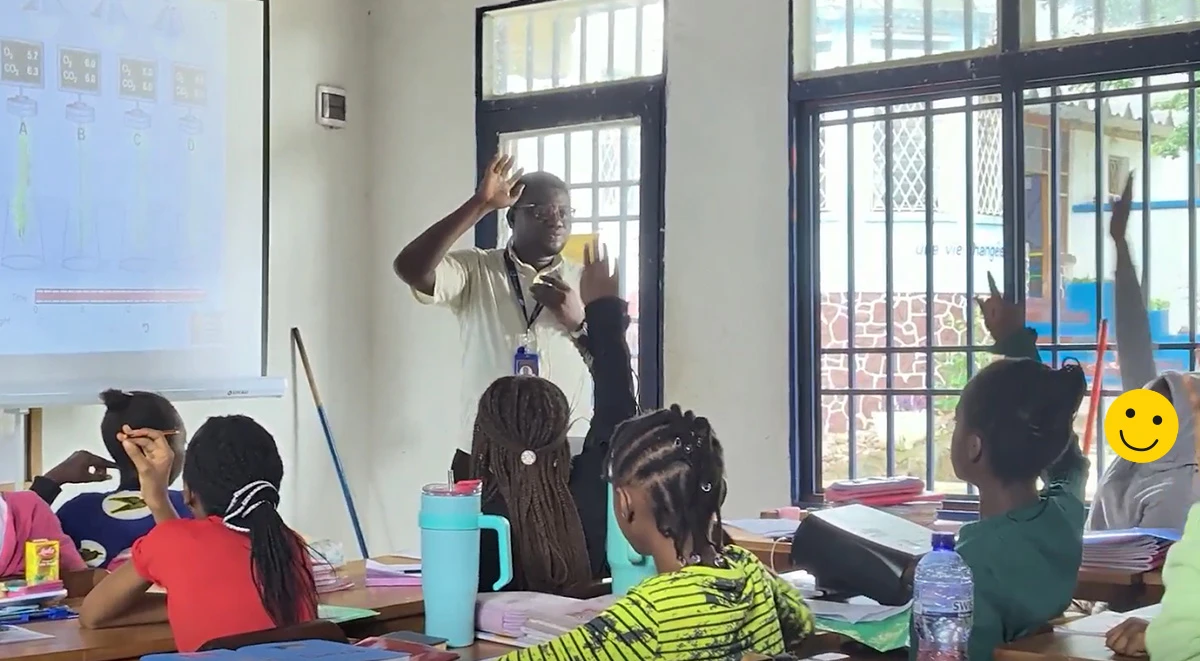
Implementing the Plants and Snails Gizmo at FATEB
After the lesson, Merlin shared how Gizmos addresses a real need across Africa, enabling virtual labs in place of physical ones. “It’s much more verbal here. Teachers speak. Students listen,” he says. “But students don’t manipulate anything. They don’t see any of what we’re actually talking about. This [speaking of Gizmos], this is practice. The students are doing rather than listening to it. Really, this responds to the different needs of teaching here in Africa.”
Insights from Kinshasa school leaders
FATEB’s director, Héritier Fima (who goes by Fima), shared this after observing a Gizmos lesson, “It creates a vivacity–a life in the classroom–where students are in the image and see the reality of what’s being taught!”
As director, Fima ensures that teachers have regular opportunities for professional development. He continually seeks innovative ways to make the school more sustainable and to enhance student learning.
When asked about his motivation for joining the pilot, he explained his excitement to try new learning methods that push students out of their comfort zones and help them learn in different ways. And he’s already seeing a shift in their excitement.
“Do we see progress that aligns with our expectations? Yes, absolutely. When school ends, the students using the applications don’t want to go home,” he said. “They gather with their computers and say they still have things to do, things to add. They’re excited. This didn’t happen before. They are engaged and improving. That shows real interest and learning progress. Personally, I’m proud of what’s happening here.”
Pasteur Guylain, owner and director of Medik, discussed how Gizmos give students a window into science, showing them how plants absorb carbon dioxide and release oxygen, how the seasons work, and how shadows change.
“The children are delighted because they can finally see what we have always described in theory.” – Pasteur Guylain, Owner and Director of Medik
Fima is eager to see implementation spread across the region. “A very good door is opening for Kinshasa. Our objective is to receive and pass things along. We don’t want to receive things that stay with us—they must go through others so they reach thousands and thousands!”
When the discussion shifted from science to math, Fima shared an experience common among primary schools worldwide: students often develop a dislike or frustration with math. Luckily, game-based solutions like Frax and Reflex, paired with passionate teacher buy-in, are already changing students' perceptions and math confidence.
“The fact that the children simply play while doing things, they don’t realize they are doing things that are also difficult. And you see, it’s the method that changes. So instead of just standing at the board explaining x² and fractions–where sometimes it goes over the children’s heads–the child manipulates it himself and sees how it changes. It gives him the desire to continue. So these are the things we’ve experienced and want to continue to see, to give children the desire to do math in our schools.”
Time-saving tools with offline materials
In the DRC, educators are legally required to provide a written summary for every lesson, a task that consumes valuable time within already brief 40-minute periods. During the pilot, Gizmos Teacher Guides helped streamline lesson preparation and delivery, allowing teachers to reclaim more instructional time.
“So with Gizmos, instead of spending an entire day writing, doing research, he [the teacher] might spend two or three hours, allowing him to prepare many things for his students… So you see, it completely reduces the workload for teachers. They are very proud of that, and I, as the administrator, am very very, very pleased,” explained Fima.
“At the beginning, it seemed difficult because it was a new subject. Using the computer at the same time, projecting at the same time, speaking to the children… it was a shock. But once they got into it, they understood how it works. They find that it makes the work easier here at FATEB.” – Fima, Director of FATEB Kinshasa Academy
Student engagement on the rise with virtual tools
Across all of the schools participating in the pilot, a common theme emerged. Implementing these solutions increased student motivation and engagement. “In terms of motivating the children, capturing their attention — really, the teacher does not need to make extra effort,” shared Pasteur Guylain. “When we use it, and we launch it, the children stop whatever they were doing—the noise of 30 or 40 children stops—and everyone pays attention. And that is fantastic.”
What’s next for ExploreLearning Global Impact
With teachers trained and students energized, the pilot is in full swing, and we’re eager to continue sharing the impact. Before implementation began, directors hosted classroom observations, and will do so again during Gizmos lessons and again later in a non-Gizmos lesson to see if inquiry-based practices and student engagement persist. Additional data will come from end-of-year test scores, comparing historical results with those from classes using Gizmos, Reflex, and Frax.
We’re continuing to unlock new possibilities for how we serve communities and operate at scale. The journey ahead is full of opportunity, and thanks to our incredible partner schools, this pilot has already laid a powerful foundation.
Ready to experience the impact in your own classroom? Get started with a free trial to bring Gizmos, Frax, or Reflex to your students.