Opening soon: Reflex and Frax classroom grants
Which math gaps are you working to close: math fact fluency, fractions, or both?
The math foundational skills developed in elementary school have the potential to unlock long-term success for your students. Math fact fluency can free up students’ working memory, and it’s one of the strongest predictors of standardized test performance. And what about fractions? Research shows that knowledge of fractions significantly impacts students’ understanding of algebra and advanced math.
Close learning gaps and ignite math confidence with a classroom math grant! Selected teachers in grades 2-8 will receive free access to Reflex or Frax for the 2026-2027 school year (up to 40 students). Applications for this once-a-year grant open on July 13, but you can get started today. Submit your interest for a math fact fluency or fractions teacher math grant!
Zap the gaps. Accelerate math growth.
Choose the math solution that best aligns with your classroom needs and complete an interest form for exclusive early access to the grant application questions! After you submit your information, we’ll email you a sneak peek of the questions so you can get a head start on your answers. We’ll notify you with more details as soon as grants open on July 13.
Submit your interest form before July 13 and get:
- Early access to the application questions
- Early review from the Math Grant committee
- Potential for full grade-level access


Reflex: Power math fact fluency
Adaptive and individualized, Reflex is the most effective and fun system for mastering basic facts in addition, subtraction, multiplication, and division.
- Engaging and motivating. Reflex continuously monitors math performance to help students build math strength at their own pace, while fun games and rewards boost motivation and confidence.
- Student success. Built on a fact family approach, Reflex meets all students to develop fact fluency speed and accuracy. Across all achievement levels, students who used Reflex with high fidelity outscored their peers.
- Reporting: Reflex includes intuitive and powerful reporting for teachers, schools, and districts to monitor student usage and celebrate progress.
- Response to Intervention (RTI): Reflex helps students at all intervention tiers succeed.
Read additional Reflex Grant program details.
Frax: Ignite fractions understanding
Frax stops the fraction struggle through an adaptive, game-based system that helps students build a strong understanding of fractions for ongoing success in higher mathematics.
- Foundational instruction. Students work extensively with length models and number lines to understand fractions as numbers first.
- Research-based success. Across all achievement levels, students who use Frax meet or exceed growth benchmarks at significantly higher rates.
- Engaging and effective. Each Frax mission features game-based challenges that build conceptual understanding while motivating students with rewards for effort and progress.
- Classroom support. With Frax offline activities, comprehensive support materials, and progress monitoring, educators can discover when students are struggling and how to help.
Read additional Frax Grant program details.
Zap the gaps and build math momentum with Reflex and Frax
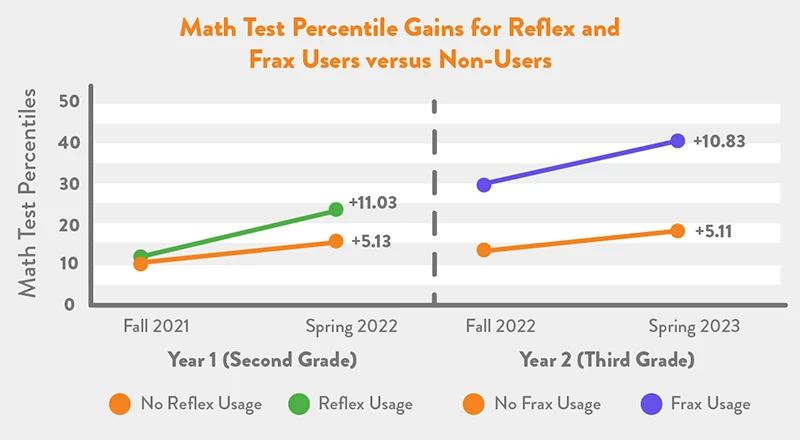
Research conducted by ExploreLearning found that elementary students using Reflex (for math facts) and Frax (for fractions) experienced larger score gains than non-users, and the most academically at-risk demonstrated even greater growth.
Students who used Reflex and Frax were…
- 60% more likely to exceed or meet typical growth goals
- 100% more likely to exceed or meet stretch growth goals
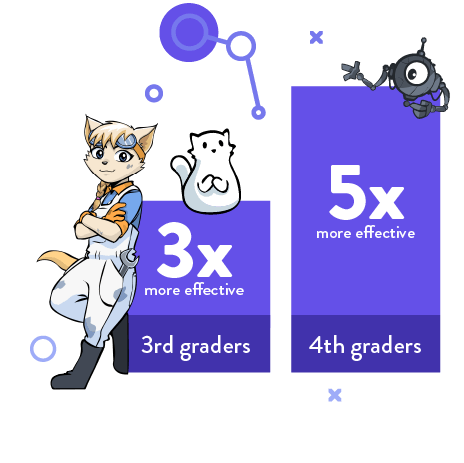
Additional research, determined by an independent review to meet the ESSA Tier 2 rating for evidence-based interventions, found Frax was 3x more effective than the average educational intervention for 3rd graders and 5x more effective for 4th graders.
A separate two-year study found that 2nd graders who scored two or more grade levels below their peers in math improved by an average of 11 percentile points when they used Reflex, compared to 5 percentile points in non-users. When those same Reflex users advanced to 3rd grade and used Frax, students were 2.5x more likely to reach on-grade-level math proficiency by the end of 3rd grade compared to non-users.