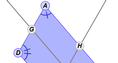
Parallelogram Conditions


Apply constraints to a dynamic quadrilateral. Then drag its vertices around. Determine which constraints guarantee that the quadrilateral is always a parallelogram.

Time remaining to use this Gizmo: 5:00     Extend your five minute free pass.

Assessment Questions (4):

  1. Find the values of x and y for which ABCD must be a parallelogram.

    image shows a quadrilateral with a side of length 3x and opposite side of length 21, a side of length 2y + 3 and opposite side of length 15.
  2. Find the values of x and y for which ABCD must be a parallelogram.

    image shows a quadrilateral and its diagonals.  the intersection of the diagonals divides each into two parts: one diagonal is divided into parts with lengths 4x - 8 and 20, the other into parts with lengths 2y - 6 and 28.
  3. Which of these conditions does not guarantee that a quadrilateral is a parallelogram?
  4. Find the values of x and y for which ABCD must be a parallelogram.

    image shows a quadrilateral with one diagonal shown and with bases of length 7x + 7 and 21.  The base with length 7x + 7 forms an angle of 49 degrees with the diagonal and the base of length 21 forms an angle of 2y - 1 degrees with the diagonal.

Session Timeout Notice

Your ExploreLearning user session will timeout in 5:00.

Would you like to stay logged in and continue your current session?
logout ignore