
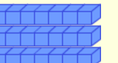
Adding Whole Numbers and Decimals (Base-10 Blocks) Use base-10 blocks to model two numbers. Then combine the blocks to model the sum. Blocks of equal value can be exchanged from one area of the mat to the other to help understand carrying when adding. Four sets of blocks are available to model different place values.


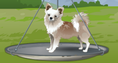
Balancing Blocks (Volume) This Gizmo provides you with two challenges. First, use blocks to build a figure with a given volume. Then, try to balance the blocks on a platform that sits on the tip of a cone. The dimensions of the platform can be adjusted, and blocks can be added or deleted by clicking on the model.
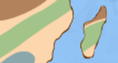
Building Pangaea In 1915, Alfred Wegener proposed that all of Earth's continents were once joined in an ancient supercontinent he called Pangaea. Wegener's idea of moving continents led to the modern theory of plate tectonics. Create your own version of Pangaea by fitting Earth's landmasses together like puzzle pieces. Use evidence from fossils, rocks, and glaciers to refine your map.


Cannonball Clowns (Number Line Estimation) Launch clowns from a circus cannon and try to hit the target. Drag digit cards on the control panel to set the launch distance and choose an appropriate unit of distance. After practicing your clown-launching skills on a number line, move on to the Big Top, Football Field, School Buses, the Golden Gate Bridge, and more!
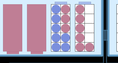
Cargo Captain (Multi-digit Subtraction) You are the captain of an interplanetary cargo ship, delivering important supplies to the outer planets. The cargo can be stored in barrels, crates, and holds. (There are 10 barrels in a crate, and 10 crates in a hold.) Model multi-digit subtraction by unloading cargo on each planet.
Chocomatic (Multiplication, Arrays, and Area) Use the Chocomatic to design candy bars made out of chocolate squares. Use multiplication to find the number of squares in each chocolate bar. Build collections of chocolate bars that all have the same number of squares. Solve multiplication problems by joining two smaller chocolate bars into a large bar.

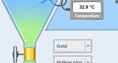
Conduction and Convection Two flasks hold colored water, one yellow and the other blue. Set the starting temperature of each flask, choose a type of material to connect the flasks, and see how quickly the flasks heat up or cool down. The flasks can be connected with a hollow pipe, allowing the water in the flasks to mix, or a solid chunk that transfers heat but prevents mixing.
Density Measure the mass and volume of a variety of objects, then place them into a beaker of liquid to see if they float or sink. Learn to predict whether objects will float or sink in water based on their mass and volume. Compare how objects float or sink in a variety of liquids, including gasoline, oil, seawater, and corn syrup.
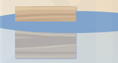
Density Experiment: Slice and Dice Drop a chunk of material in a beaker of water and observe whether it sinks or floats. Cut the chunk into smaller pieces of any size, and observe what happens as they are dropped in the beaker. The mass and volume of each chunk can be measured to gain a clear understanding of density and buoyancy.
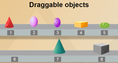
Density Laboratory With a scale to measure mass, a graduated cylinder to measure volume, and a large beaker of liquid to observe flotation, the relationship between mass, volume, density, and flotation can be investigated. The density of the liquid in the beaker can be adjusted, and a variety of objects can be studied during the investigation.
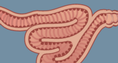
Digestive System Digestion is a complex process, involving a wide variety of organs and chemicals that work together to break down food, absorb nutrients, and eliminate wastes. But have you ever wondered what would happen if some of those organs were eliminated, or if the sequence was changed? Can the digestive system be improved? Find out by designing your own digestive system with the Digestive System Gizmo.
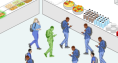
Disease Spread Observe the spread of a disease through a group of students. The disease is spread by either person-to-person contact or food. Adjust the number of people in the space, the probability of transmission, and whether students are wearing masks. Determine the factors that control how quickly the disease spreads for each disease.
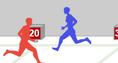
Distance-Time and Velocity-Time Graphs Create a graph of a runner's position versus time and watch the runner run a 40-yard dash based on the graph you made. Notice the connection between the slope of the line and the velocity of the runner. Add a second runner (a second graph) and connect real-world meaning to the intersection of two graphs. Also experiment with a graph of velocity versus time for the runners, and also distance traveled versus time.
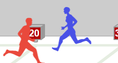
Distance-Time and Velocity-Time Graphs - Metric Create a graph of a runner's position versus time and watch the runner run a 40-meter dash based on the graph you made. Notice the connection between the slope of the line and the velocity of the runner. Add a second runner (a second graph) and connect real-world meaning to the intersection of two graphs. Also experiment with a graph of velocity versus time for the runners, and also distance traveled versus time.
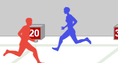
Distance-Time Graphs Create a graph of a runner's position versus time and watch the runner complete a 40-yard dash based on the graph you made. Notice the connection between the slope of the line and the speed of the runner. What will the runner do if the slope of the line is zero? What if the slope is negative? Add a second runner (a second graph) and connect real-world meaning to the intersection of two graphs.
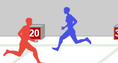
Distance-Time Graphs - Metric Create a graph of a runner's position versus time and watch the runner complete a 40-meter dash based on the graph you made. Notice the connection between the slope of the line and the speed of the runner. What will the runner do if the slope of the line is zero? What if the slope is negative? Add a second runner (a second graph) and connect real-world meaning to the intersection of two graphs.

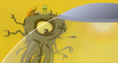
Effect of Environment on New Life Form Using the scientific method, control the environmental conditions for a fictional alien organism in order to learn how the organism responds to changes in conditions. Sunlight, water, and temperature can be varied to determine their effects on the shape of the aliens.
Elevator Operator (Line Graphs) Operate an elevator in an old apartment building. Pick up and drop off residents where they want to go. A line graph shows where the elevator traveled over time. Operate the elevator either by using the standard up and down controls, or by building a graph to program where you want it to go.

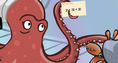
Equivalent Algebraic Expressions I Grumpy’s Restaurant is now hiring! As a new chef at this underwater bistro, you’ll learn the basics of manipulating algebraic expressions. Learn how to make equivalent expressions using the Commutative and Associative properties, how to handle pesky subtraction and division, and how to identify equivalent and non-equivalent expressions.
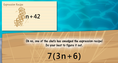
Equivalent Algebraic Expressions II Continue your meteoric rise in the undersea culinary world in this follow-up to Equivalent Algebraic Expressions I. Make equivalent expressions by using the distributive property forwards and backwards, sort expressions by equivalence, and personally assist Chef Grumpy himself with a project that will bring him (and maybe you) fame and fortune.
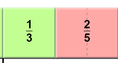
Equivalent Fractions (Fraction Tiles) Explore fractions using the Fractionator, the machine that makes fraction tiles. Compare fractions and find equivalent fractions by arranging the tiles on two horizontal rows. Explore simplifying fractions. Add fractions and express sums as improper fractions or mixed numbers.
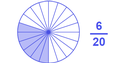
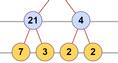
Factor Trees (Factoring Numbers) The Factor Trees Gizmo has two modes. In Factor mode, you can create factor trees to factor composite numbers into primes. In Build mode, you can build numbers by multiplying primes together. Can you build all composite numbers up to 50? Any whole composite number up to 999 can be factored or built with the Gizmo.
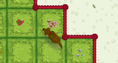
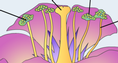
Flower Pollination Observe the steps of pollination and fertilization in flowering plants. Help with many parts of the process by dragging pollen grains to the stigma, dragging sperm to the ovules, and removing petals as the fruit begins to grow. Quiz yourself when you are done by dragging vocabulary words to the correct plant structure.
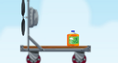
Force and Fan Carts Explore the laws of motion using a simple fan cart. Use the buttons to select the speed of the fan and the surface, and press Play to begin. You can drag up to three objects onto the fan cart. The speed of the cart is displayed with a speedometer and recorded in a table and a graph.
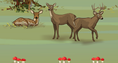
Forest Ecosystem Observe and manipulate the populations of four creatures (trees, deer, bears, and mushrooms) in a forest. Investigate the feeding relationships (food web) in the forest. Determine which creatures are producers, consumers, and decomposers. Pictographs and line graphs show changes in populations over time.

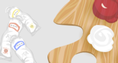
Fraction Artist 2 (Area Models of Fractions) Extend understanding of fractions by making modern paintings in the style of Piet Mondrian. Create and analyze paintings with different-sized sections. Compare the sizes of unit fractions. Find creative ways to color one-half of a painting. This can be a nice introduction to adding fractions with unlike denominators.
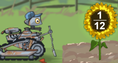
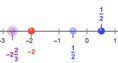
Fraction Garden (Comparing Fractions) Plant flowers in two gardens to help develop fraction sense. The two gardens act as number lines, from 0 to 1. Use the flowers in the gardens to compare fractions and to explore equivalent fractions. Chalk marks can be drawn to divide the garden into equal sections.
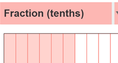
Fraction, Decimal, Percent (Area and Grid Models) Model and compare fractions, decimals, and percents using area models. Each area model can have 10 or 100 sections and can be set to display a fraction, decimal, or percent. Click inside the area models to shade them. Compare the numbers visually or on a number line.
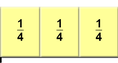
Fractions Greater than One (Fraction Tiles) Explore fractions greater than one with the Fractionator, a fraction-tile-making machine in the Gizmo. Create sums of fraction tiles on two number lines. Sums greater than one are shown as improper fractions on the top number line, and as mixed numbers on the bottom number line.
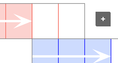
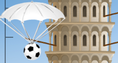
Free Fall Tower Recreate Galileo's famous experiment by dropping objects off the Tower of Pisa. You can drop ping pong balls, golf balls, soccer balls or watermelons. Objects can be dropped in air or no air, with or without a parachute. The speed of each object is shown on a speedometer and a graph.
Function Machines 1 (Functions and Tables) Drop a number into a function machine, and see what number comes out! You can use one of the six pre-set function machines, or program your own function rule into one of the blank machines. Stack up to three function machines together. Input and output can be recorded in a table and on a graph.
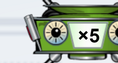
Function Machines 2 (Functions, Tables, and Graphs) Drop a number into a function machine, and see what number comes out! You can use one of the six pre-set function machines, or program your own function rule into one of the blank machines. Stack up to three function machines together. Input and output can be recorded in a table and on a graph.
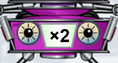
Function Machines 3 (Functions and Problem Solving) Drop a number into a function machine, and see what number comes out! You can use one of the six pre-set function machines, or program your own function rule into one of the blank machines. Stack up to three function machines together. Input and output can be recorded in a table and on a graph.
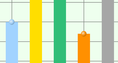
Graphing Skills Create a graph (bar graph, line graph, pie chart, or scatter plot) based on a given data set. Title the graph, label the axes, and choose a scale. Adjust the graph to fit the data, and then check your accuracy. The Gizmo can also be used to create a data table based on a given graph.
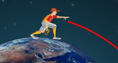
Gravity Pitch Imagine a gigantic pitcher standing on Earth, ready to hurl a huge baseball. What will happen as the ball is thrown harder and harder? Find out with the Gravity Pitch Gizmo. Observe the path of the ball when it is thrown at different velocities. Throw the ball on different planets to see how each planet's gravity affects the ball.
Greenhouse Effect - Metric Within this simulated region of land, daytime's rising temperature and the falling temperature at night can be measured, along with heat flow in and out of the system. The amount of greenhouse gases present in the atmosphere can be adjusted through time, and the long-term effects can be investigated.
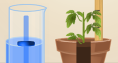
Growing Plants Investigate the growth of three common garden plants: tomatoes, beans, and turnips. You can change the amount of light each plant gets, the amount of water added each day, and the type of soil the seed is planted in. Observe the effect of each variable on plant height, plant mass, leaf color and leaf size. Determine what conditions produce the tallest and healthiest plants. Height and mass data are displayed on tables and graphs.
Hearing: Frequency and Volume Test your hearing range by listening to low-, medium-, and high-frequency sounds. Compare the relative loudness of sounds at each frequency to create an equal-loudness curve. In a quiet room, measure your threshold of audibility for each frequency, and compare your results to others. The volume of each sound can be adjusted.
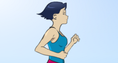
Homeostasis Control a simulated person running on a treadmill. Your challenge is to use clothing, exercise, and sweat to maintain a constant body temperature as air temperature goes up and down. Sweating (perspiration) can be controlled automatically by the Gizmo or, for a challenge, manually by the user. Don't forget to eat and drink!

Household Energy Usage Explore the energy used by many household appliances, such as television sets, hair dryers, lights, computers, etc. Make estimates for how long each item is used on a daily basis to get an estimate for the total power consumed during a day, a week, a month, and a year, and how that relates to consumer costs and environmental impact.
Human Homeostasis Adjust the levels of clothing, perspiration, and exercise to maintain a stable internal temperature as the external temperature changes. Water and blood sugar levels need to be replenished regularly, and fatigue occurs with heavy exercise. Severe hypothermia, heat stroke, or dehydration can result if internal stability is not maintained.

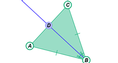
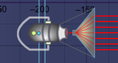
Laser Reflection Point a laser at a mirror and compare the angle of the incoming beam to the angle of reflection. A protractor can be used to measure the angles of incidence and reflection, and the angle of the mirror can be adjusted. A beam splitter can be used to split the beam. Both plane and irregular mirrors can be used.
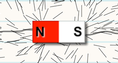
Magnetism Drag bar magnets and a variety of other objects onto a piece of paper. Click Play to release the objects to see if they are attracted together, repelled apart, or unaffected. You can also sprinkle iron filings over the magnets and other objects to view the magnetic field lines that are produced.
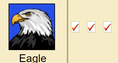
Mascot Election (Pictographs and Bar Graphs) A brand new school is opening and it is time to elect the school mascot! Students can choose the Eagle, Lion, Bear, or Wolf. Voting results can be displayed in a table, tally chart, pictograph, bar graph, circle graph, or dot plot. You can change student votes by selecting a group of students and clicking a mascot.

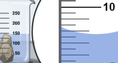
Measuring Volume Measure the volume of liquids and solids using beakers, graduated cylinders, overflow cups, and rulers. Water can be poured from one container to another and objects can be added to containers. A pipette can be used to transfer small amounts of water, and a magnifier can be used to observe the meniscus in a graduated cylinder. Test your volume-measurement skills in the "Practice" mode of the Gizmo.
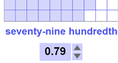
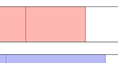
Modeling Fractions (Area Models) Model and compare fractions using area models. Set the denominators with the arrow buttons, and then set the numerators with the arrow buttons or by clicking in the models. Compare fractions visually, on a number line, or numerically using the least common denominator.
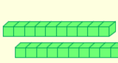
Modeling Whole Numbers and Decimals (Base-10 Blocks) Model numbers with base-10 blocks. Drag flats, rods, and individual cubes onto a mat to model a number. Blocks can be exchanged from one area of the mat to the other. Four sets of blocks are available to model a variety of whole numbers and decimals.
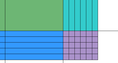
Multiplying Decimals (Area Model) Model the product of two decimals by finding the area of a rectangle. Estimate the area of the rectangle first. Then break the rectangle into several pieces and find the area of each piece (partial product). Add these areas together to find the whole area (product).
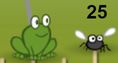
Number Line Frog Hop (Addition and Subtraction) Live a frog's life as you hop along a number line in search of flies. Learn how addition and subtraction can be represented as movement along a number line. Fred the frog may even help you get better at adding and subtracting two-digit numbers in your head by decomposing them into tens and ones.
Ocean Mapping Use a sonar on a boat to remotely measure the depth of an ocean at various locations. Describe multiple points on the ocean floor using their latitude, longitude, and depth. View maps of ocean depth in two and three dimensions, and use these maps to plot a safe route for ships to follow.
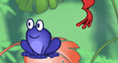
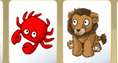
Pattern Flip (Patterns) In the Pattern Flip carnival game, you are shown a pattern of cards. The first cards are face-up so you can see the pattern, and the rest are face-down. Can you guess which animals are on the face-down cards? Use one of the preset patterns, or make your own custom pattern. Good luck!
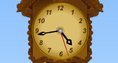

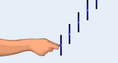
Penumbra Effect Observe the partial shadows cast by a rectangular block lit by multiple light sources. The number of light sources ranges from one to five, and individual lights can be turned on or off. The light spacing, block width, and distance from the lights to the block can be varied. Light intensity can be observed on a detector.
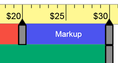
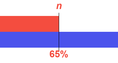

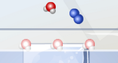
Phase Changes Explore the relationship between molecular motion, temperature, and phase changes. Compare the molecular structure of solids, liquids, and gases. Graph temperature changes as ice is melted and water is boiled. Find the effect of altitude on phase changes. The starting temperature, ice volume, altitude, and rate of heating or cooling can be adjusted.
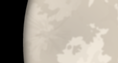
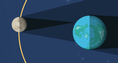
Phases of the Moon Understand the phases of the Moon by observing the positions of the Moon, Earth and Sun. A view of the Moon from Earth is shown on the right as the Moon orbits Earth. Learn the names of Moon phases and in what order they occur. Click Play to watch the Moon go around, or click Pause and drag the Moon yourself.
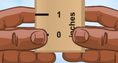
Reaction Time 1 (Graphs and Statistics) Test your reaction time by catching a falling ruler or clicking a target. Create a data set of experiment results, and calculate the range, mode, median, and mean of your data. Data can be displayed on a list, table, bar graph or dot plot. The Reaction Time 1 Student Exploration focuses on range, mode, and median.
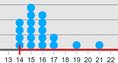
Reaction Time 2 (Graphs and Statistics) Test your reaction time by catching a falling ruler or clicking a target. Create a data set of experiment results, and calculate the range, mode, median, and mean of your data. Data can be displayed on a list, table, bar graph or dot plot. The Reaction Time 2 Student Exploration focuses on mean.
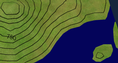
Reading Topographic Maps Understand how topographic maps work by creating a three-dimensional landscape and observing the corresponding contour lines. See how mountains, depressions, valleys and cliffs are represented on topographic maps. Fill in the landscape with water to demonstrate that contours are lines of constant elevation.
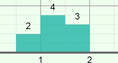
Real-Time Histogram Try to click your mouse once every 2 seconds. The time interval between each click is recorded, as well as the error and percent error. Data can be displayed in a table, histogram, or scatter plot. Observe and measure the characteristics of the resulting distribution when large amounts of data are collected.
Reverse the Field Measure the time required to write a word when the mouse behaves in a normal fashion and when the direction of motion is reversed from left to right, up to down, or both. Run several experiments in each mode to see if your brain and muscles are able to adapt to the new direction of motion. Determine which type of inversion is easiest to adjust to and whether you can train yourself to function normally when the inversion is present.
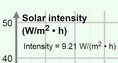
Seasons Around the World Use a three dimensional view of the Earth, Moon and Sun to explore seasonal changes at a variety of locations. Strengthen your knowledge of global climate patterns by comparing solar energy input at the Poles to the Equator. Manipulate Earth's axis to increase or diminish seasonal changes.
Seasons in 3D Gain an understanding of the causes of seasons by observing Earth as it orbits the Sun in three dimensions. Observe the path of the Sun across the sky on any date and from any location. Create graphs of solar intensity and day length, and use collected data to describe and explain seasonal changes.
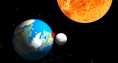
Seasons: Earth, Moon, and Sun Observe the motions of the Earth, Moon and Sun in three dimensions to explain Sunrise and Sunset, and to see how we define a day, a month, and a year. Compare times of Sunrise and Sunset for different dates and locations. Relate shadows to the position of the Sun in the sky, and relate shadows to compass directions.
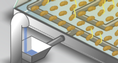
Seed Germination Perform experiments with several seed types to see what conditions yield the highest germination (sprouting) rate. Three different types of seeds can be studied, and the temperature, water and light in the germination chamber can be controlled. No two trials will have the same result so repeated trials are recommended.

Sight vs. Sound Reactions Measure your reaction time by clicking your mouse as quickly as possible when visual or auditory stimuli are presented. The individual response times are recorded, as well as the mean and standard deviation for each test. A histogram of data shows overall trends in sight and sound response times. The type of test as well as the symbols and sounds used are chosen by the user.

Sled Wars Explore acceleration, speed, momentum, and energy by sending a sled down a hill into a group of snowmen. The starting height and mass of the sled can be changed, as well as the number of snowmen. In the Two sleds scenario, observe collisions between sleds of different masses and starting heights.
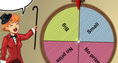
Spin the Big Wheel! (Probability) Step right up! Spin the big wheel! Each spin can result in no prize, a small prize, or a big prize. The wheel can be spun by 1, 10, or 100 players. Results are recorded on a frequency table or a circle graph. You can also design your own wheel and a sign that describes the probabilities for your wheel.
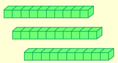
Subtracting Whole Numbers and Decimals (Base-10 Blocks) Use base-10 blocks to model a starting number. Then subtract blocks from this number by dragging them into a subtraction bin. Blocks of equal value can be exchanged from one section of the mat to the other to help understand regrouping and borrowing. Four sets of blocks are available to model different place values.

Subtractive Colors Move spots of yellow, cyan, and magenta pigment on a white surface. As the colors overlap, other colors can be seen due to color subtraction. The color of most things you see--such as cars, leaves, paintings, houses, and clothes--are due to color subtraction. The intensity of the cyan, magenta, and yellow can be adjusted, and the RGB value at any location can be measured.
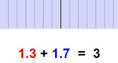
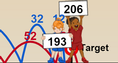
Target Sum Card Game (Multi-digit Addition) Play an addition card game! The goal is to create a sum that is as close as possible to the target sum. Students will deepen their understanding of place value as they get better at playing the game. Many game options allow students to vary the game for more practice. The game can be played with one or two players.
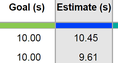
Time Estimation Try to estimate the passage of time by selecting a time interval, clicking the Start button, and clicking Stop when you think the interval has passed. The estimate and percent error are recorded. Compare different techniques for estimating time, as well as the average error for long time intervals versus shorter intervals.
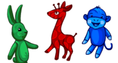
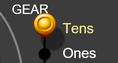
Treasure Hunter (Decimals on the Number Line) Drive a desert highway searching for buried treasure. Learn to use the car's tens, ones, tenths, and hundredths gears, along with a GPS system (number line), to find the right place to dig. Plot your findings on a zoomable number line map. Can you become a master Treasure Hunter?

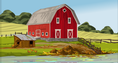
Water Pollution Get to know the four main types of pollution present in the environment, and then look at a variety of real-world examples as you try to guess what type of pollution is represented by each situation. All of the real-world situations can be viewed every day in different parts of the world.